Why Your To-Do List Isn’t the Problem:
The Brutal Truth About Stress and How to Reset
1. The Morning After-Shock: Misdiagnosing Your Cognitive Load
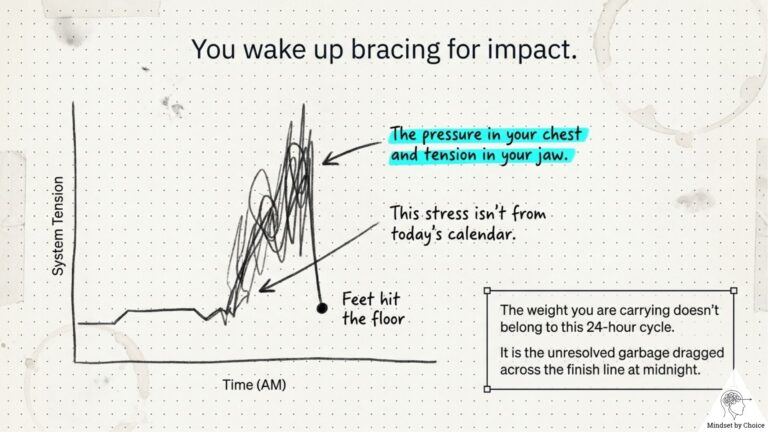
Many high performers wake up and, before their feet even hit the floor, they are already “bracing for impact.” You feel the physiological symptoms immediately: a crushing pressure in your chest and a tightening in your jaw. While you may blame the meetings and deadlines on today’s calendar, you are likely misdiagnosing the root cause of your cognitive load.
The brutal truth is that your stress isn’t just a response to today’s schedule; it is the “unresolved garbage” you dragged across the finish line at midnight. We have a systemic habit of carrying yesterday’s concerns into our present-day reality, effectively sabotaging our operational bandwidth before the day begins.
2. The Invisible Backpack: Why You Feel Like You’re Failing
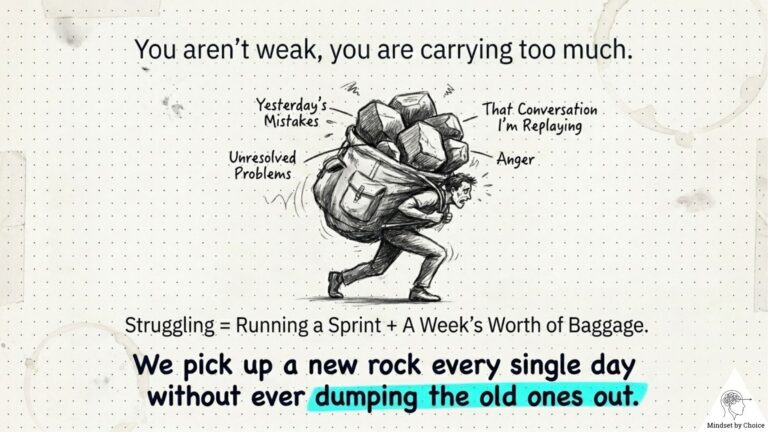
Stress functions as an accumulation—a systemic weight that builds over time. Think of it as an invisible backpack. Every day you carry it, you pick up a new rock. If you never “dump the load,” the weight eventually becomes unbearable, leading to a total system crash.
“Most of us are walking around today carrying a weight that doesn’t even belong to this 24-hour cycle… You aren’t failing because you’re weak. You’re struggling because you’re trying to run a sprint while carrying a week’s worth of heavy baggage.”
To perform at your peak, you must understand that “dumping the load” is a non-negotiable prerequisite. When you carry the “cognitive residue” of yesterday—the conversations you’re replaying or the mistakes you’re ruminating on—you are siphoning off the mental energy needed for today’s high-stakes decisions. You cannot navigate a new sprint while hauling a week’s worth of baggage.
3. Tactical Recovery: The Operational HQ
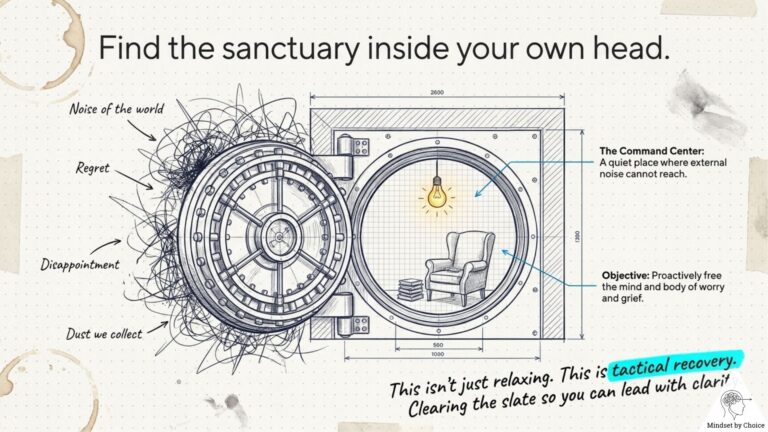
Lowering stress requires “Tactical Recovery,” a proactive strategy to clear the “dust” of regret, disappointment, and anger from your system. This is not passive relaxation; it is an active clearing of the slate to regain mental clarity.
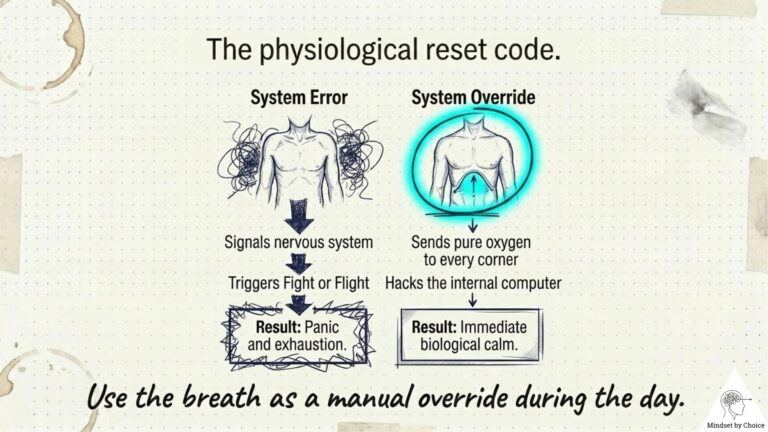
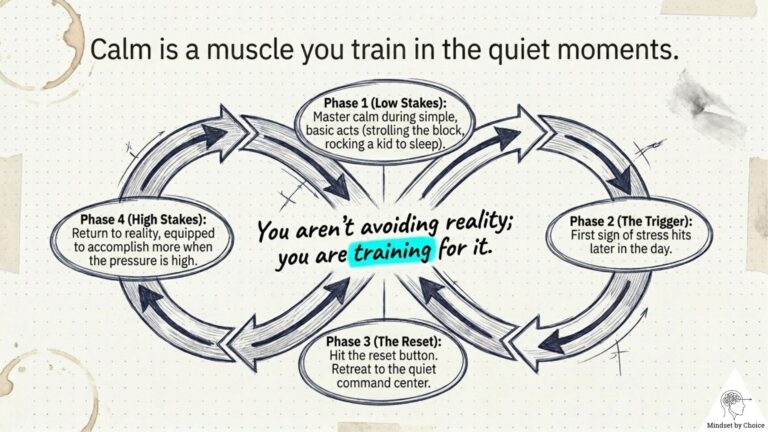
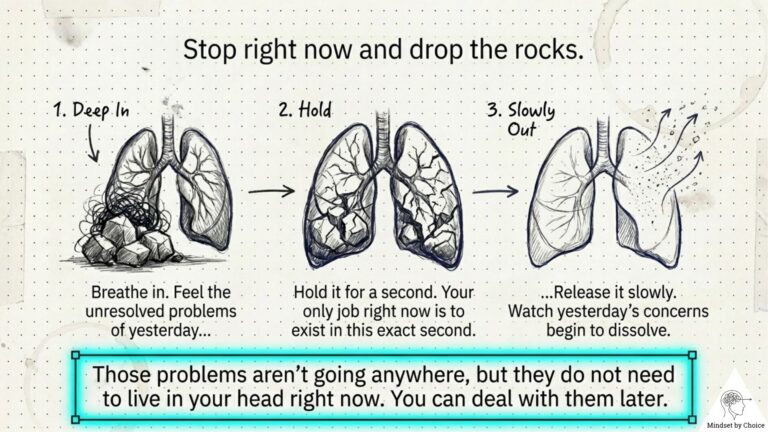
The primary tool for this is the Reset Code for your internal computer: deep belly breathing. Most people under stress resort to shallow chest breaths, which signal a “fight or flight” response to the nervous system. By shifting to deep belly breaths—inhaling deeply, holding for a second, and releasing slowly—you send pure oxygen to every corner of your body and manually override the stress signal.
This technique allows you to access your “inner quiet place.” Think of this sanctuary as your Operational HQ—a command center where the noise of the external world cannot reach, allowing you to exist entirely in the present second.
4. Mindful Action: Training the Muscle of Calm
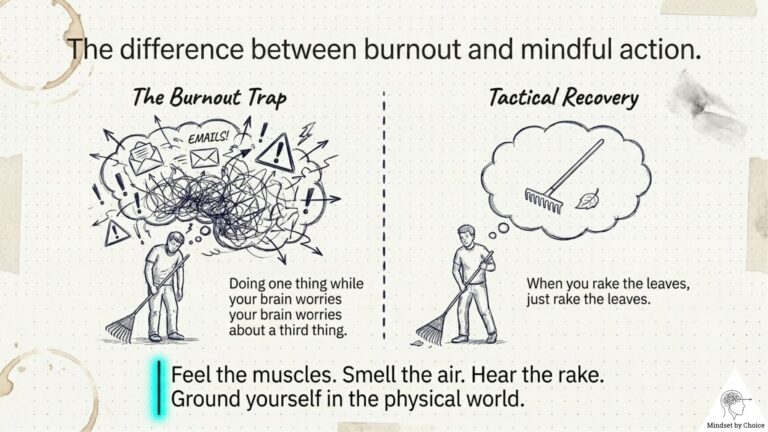
Once the mental space is cleared, you must ground your system in the physical world through “Mindful Action.” This involves selecting a low-stakes tactical objective—such as raking leaves, a stroll around the block, or rocking a child—and performing it with absolute focus.
Burnout occurs when the brain is worrying about a third task while the body is performing a first. When you rake the leaves, simply rake the leaves. Smell the air, feel the tension in your muscles, and hear the sound of the rake. Mastering the ability to maintain internal calm during these simple tasks is how you train the “muscle” required to perform when the stakes are high.
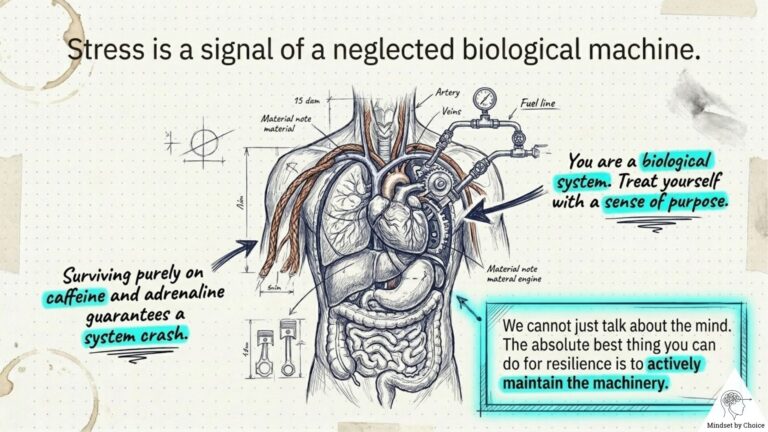
5. The Machine: Stress as a Biological System Signal
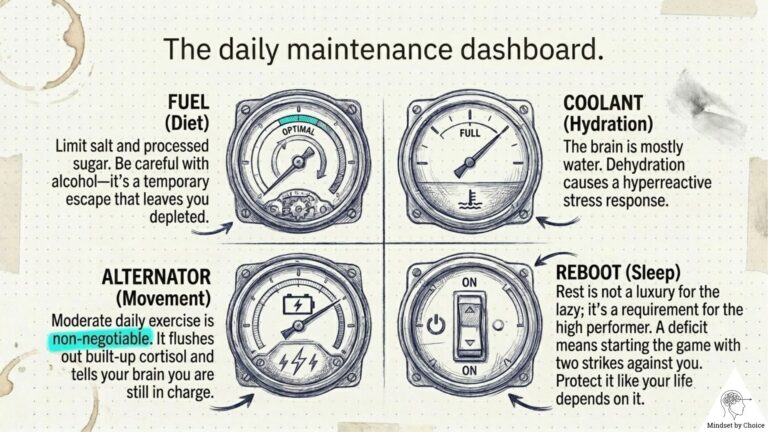
Your body is the hardware upon which your mental software runs. Stress is often a signal that the “machine” is being neglected. To build systemic resilience, you must treat your biological requirements as high-performance fuel:
- Hydration: The brain is predominantly water. In a state of dehydration, your stress response becomes hyperreactive. Clean water is the lubricant for your cognitive gears.
- Movement: Moderate daily exercise is a non-negotiable system flush. It moves cortisol out of your system and nourishes your vital organs, breathing new life into your skin and hair. Movement is how you tell your brain that you are in charge.
- Sleep: Rest is not a luxury for the lazy; it is a requirement for the high performer. Starting a day on a sleep deficit is like starting a game with two strikes already against you.
- System Depletors: To prevent system depletion, you must strictly limit the intake of salt, processed sugar, caffeine, and alcohol. These substances offer a temporary “escape” but ultimately leave the biological machine more compromised than before.
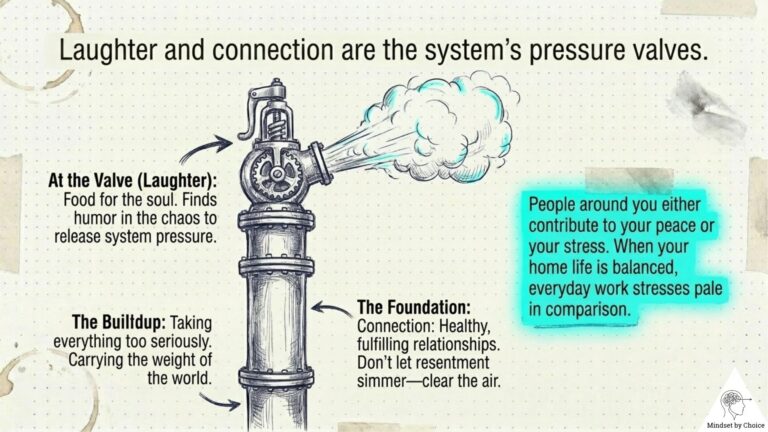
Beyond the physical, remember that laughter acts as a “pressure valve” for the soul, and fulfilling relationships provide the foundation for your peace.
6. The Ripple Effect: The Single Stressor Strategy
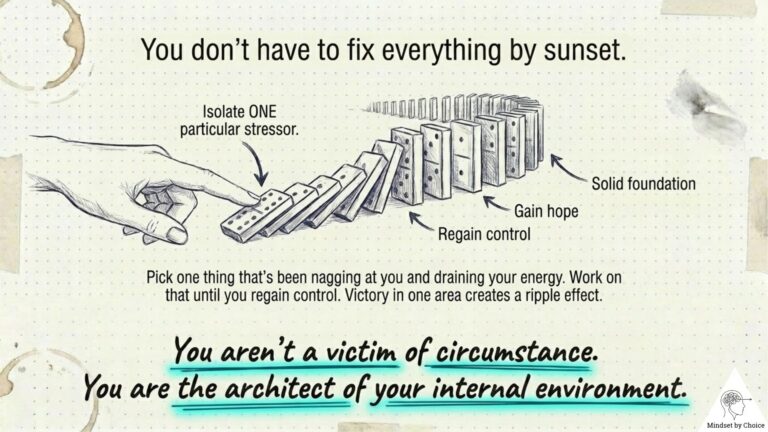
Attempting to overhaul your entire life by sunset is a strategic error that only compounds stress. Instead, utilize a High-Leverage Move: the Single Stressor Strategy. Isolate one specific problem that has been draining your energy—one “rock” in the backpack—and work on that one thing exclusively until you regain control.
Victory in one area creates a ripple effect of self-efficacy. Regaining control over one stressor restores the hope and momentum needed to tackle the rest of the system. You are not a victim of your circumstances; you are the architect of your internal environment.
7. Conclusion: The 24-Hour Commitment
Transitioning from a victim of stress to a performance strategist starts with a simple realization: you have the capacity to handle today, provided you stop carrying last week with it. By dumping the weight of yesterday and optimizing the biological needs of the present, you secure the clarity needed to lead.
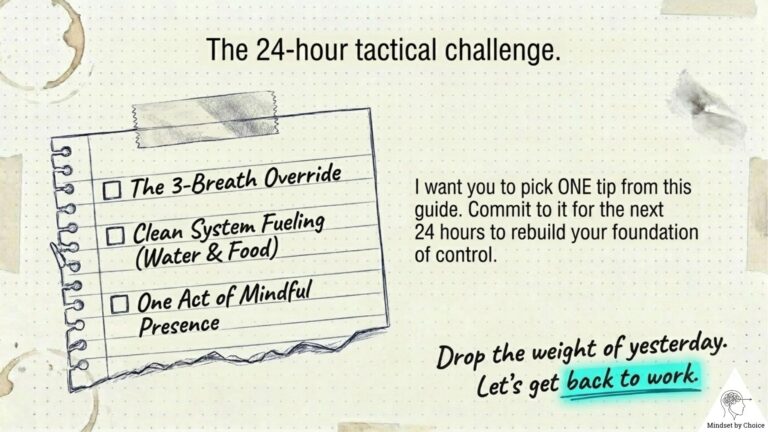
The 24-Hour Tactical Objective: Choose one specific optimization to commit to for the next 24 hours:
- Initiate the “Reset Code” through deep belly breathing.
- Clean up the “fuel” (hydration and nutrition).
- Engage in one act of “Mindful Action.”
Final Thought:
Which specific rock are you ready to take out of your backpack today?