The Lie of Laziness:
Why You Aren't Actually Lazy
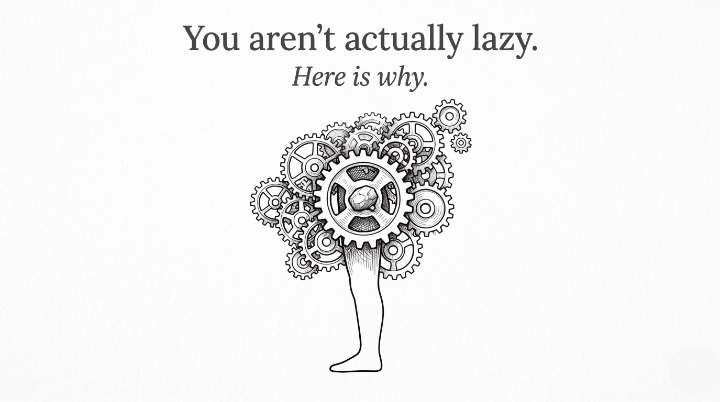
Picture the scene: sitting on the edge of a bed, eyes fixed forward on a pair of shoes, a heavy, suffocating weight pressing down on the chest while the clock counts down the hours. It is an internal freeze that feels entirely impossible to break. We reach for the nearest, sharpest word to describe this paralysis, and we call it laziness.
But this label is a convenient fiction. Laziness is an easy insult we use against ourselves when our internal engine stalls. It is a mask worn by deeper, unexamined friction points beneath the surface of our awareness, hiding the real mechanisms that keep us stuck.
“Laziness is a convenient label we throw at problems we do not understand. It is an easy insult we use against ourselves when our internal engine stalls.”
Part I: The Hidden Leaks
When the internal engine stalls, we habitually blame our character instead of investigating our mechanics. The first hidden leak is emotional avoidance masquerading as a lack of care. We do not shrink back from the ultimate outcome; we shrink from the friction, dread, or discomfort of the immediate process.
This is not a failure of will, but an emotional defense strategy. If you want to break the cycle, you have to stop fighting the phantom of laziness and start addressing the specific fear associated with the task.
Another massive leak occurs when our biological battery drops to zero. In a culture that treats exhaustion as a badge of honor, we starve our bodies of rest and then wonder why the mind refuses to cooperate.
If your biological battery is drained to zero, no amount of mindset work will fix it. When physical energy vanishes, inaction is not a choice; it is a desperate cry for survival.
Part II: The High-Value Trade-Offs
The mind will naturally rebel against tasks that feel entirely disconnected from our deepest internal standards. If a project feels boring or inconsequential to our personal values, the brain protects its resources by shutting down.
To overcome this resistance, we must connect the tedious process to a grander architectural vision. We do not endure the struggle for the task itself, but because of who we become on the other side of that effort.
We must also confront the heavy price of hopelessness. When a person secretly expects to fail, the mind builds a protective wall of inaction to avoid the sting of despair.
“Why run a race if you are convinced the finish line will be moved?”
Similarly, when faced with an abundance of choices, indecisiveness paralyzes our forward movement. We choose the default option of standing completely still because the fear of taking the wrong turn outweighs our desire for progress.
Part III: The Blueprint for Freedom
True movement does not require a sudden bolt of inspiration. The great myth is that motivation must precede action, when in reality, motivation is merely the symptom of movement itself. The energy you are looking for is generated by the movement itself. We must build the discipline to move when we are cold, trusting that the warmth will arrive only after we have started running.
If direction is missing, we cannot wait for perfect clarity to arrive through thinking alone. Stagnation breeds nothing but regret, whereas any progress, no matter how messy, provides invaluable data. Purpose is forged through action, by trying things until an internal spark finally clicks.
The Take Action Bridge
Dismantling the prison of inertia requires looking beneath the surface and choosing a new path forward. If you are ready to stop fighting the phantom of laziness and begin building real, sustainable momentum, it is time to take the next step.
Download Your Identity Audit Worksheet
Stop drifting.
Turn the insights from this article into raw, actionable clarity.
Enter your email below to get the minimalist PDF blueprint and audit your internal standards, proximity circle, and hidden scripts right now.
Identity Audit Worksheet
is on the way to your email.
Chceck it right now!
Q&A: Understanding Time Reclamation
What is the main difference between being lazy and experiencing emotional avoidance?
Laziness implies a total lack of desire to achieve an outcome or improve our circumstances. Emotional avoidance, however, occurs when we deeply care about the results but feel completely overwhelmed by the dread, anxiety, or complexity of the immediate process. The external behavior looks identical, but the internal solution requires processing the underlying fear rather than forcing compliance through self-insult.
How can someone generate motivation when they feel completely cold and uninspired?
The secret lies in reversing the traditional sequence of action by understanding that motivation follows movement rather than causing it. Waiting for a feeling of inspiration gives away our personal power to a fluctuating emotional state. By initiating a tiny, simple action even while feeling cold, the physical movement itself stimulates the momentum and energy needed to sustain the task.
Why does a lack of clear life direction look like laziness from the outside?
When there is no clear target or sense of purpose guiding daily actions, the subconscious mind sees no logical reason to expend valuable energy. This lack of direction often leads to a default state of standing completely still, which onlookers and self-critics easily mislabel as a lack of ambition. In reality, the stagnation is a symptom of paralysis caused by a missing internal compass.
How does setting microscopic goals help break the cycle of subconscious hopelessness?
Hopelessness creates an internal shield where the mind avoids effort because it fully expects that failure is the only guaranteed outcome. By setting an incredibly tiny, almost laughable goal and successfully achieving it, you provide immediate concrete proof to yourself that your actions can change your current reality. These micro-victories rebuild trust with the person in the mirror, slowly dismantling the belief that effort is entirely pointless.
What role does physical exhaustion play in what we traditionally call a lack of discipline?
Our global environment often glorifies constant work and treats deep exhaustion as a secondary concern. When the biological battery is fully drained, the mind naturally lacks the deep reserves required to execute complex tasks or maintain a positive outlook. What looks like a failure of discipline or willpower is frequently just a desperate survival signal from an overextended body demanding deep rest.