When Everything Collapses:
The Instant Mental Reset
There is a specific kind of silence that happens when everything falls apart. It is the moment right after the storm hits, when the noise fades, and you are left standing in the cold wreckage of what you thought was your life. In those moments, it feels like the weight of the entire world is pressing down directly on your chest, making even the next breath feel like an impossible task.
Most of us build our daily routines, read the books, and carefully map out our futures under the assumption that we can control the horizon. But life possesses a brutal habit of landing heavy blows that dissolve those plans in an instant. The real question we must face is not how to avoid the punch, but what we choose to do when we are staring straight up from the canvas.
Part I: The Hidden Leaks
When a massive, destabilizing setback occurs, the first asset we lose is not our external security, but our internal memory. We develop a strange kind of situational amnesia that makes us forget who we actually are. We become convinced that the current pain is the only landscape we have ever navigated, completely erasing our history of survival.
“The first thing we lose when we hit rock bottom is our memory. We develop a strange kind of amnesia that makes us forget who we actually are.”
If we journey backward through our own history, we can always find a night where we believed the sadness would never lift, or a failure we thought would permanently define us. Yet, time passed, our internal standards adapted, and the giant that stood in the way eventually dissolved into a shadow. Falling into the trap of current pain causes us to pull away from the world, hiding in total solitude under the dangerous assumption that we must carry the weight of the universe entirely on our own shoulders.
Part II: The High-Value Trade-Offs
When life is operating at a high level, making noticeable progress requires an immense amount of energy because we are already running at capacity. But when we reach the absolute bottom, a beautiful, quiet freedom emerges because the terrifying weight of falling completely disappears. There is nowhere left to drop, meaning the only direction remaining is up.
“Reaching the absolute bottom comes with a quiet freedom. The terrifying weight of falling completely disappears because there is nowhere left to drop.”
Hitting the floor forces us to look at the person in the mirror with total, unvarnished honesty. This is the ultimate high-value trade-off: we trade the comfortable illusions of a perfect life for a completely clean blank slate. At the bottom, even the most microscopic adjustment creates a massive, echoing impact across our entire existence. It is infinitely more fulfilling to navigate a difficult situation while making slight, visible progress every single week, than it is to sit in a seemingly perfect life while slowly sliding backward.
Part III: The Blueprint for Freedom
To shift our momentum when everything is crashing down, we have to consciously weaponize our perspective. The mind defaults to tracking what is broken, but emotional survival requires us to force our focus toward appreciation. This is not about empty positivity; it is about shifting the internal chemistry from a state of threat to a state of discovery.
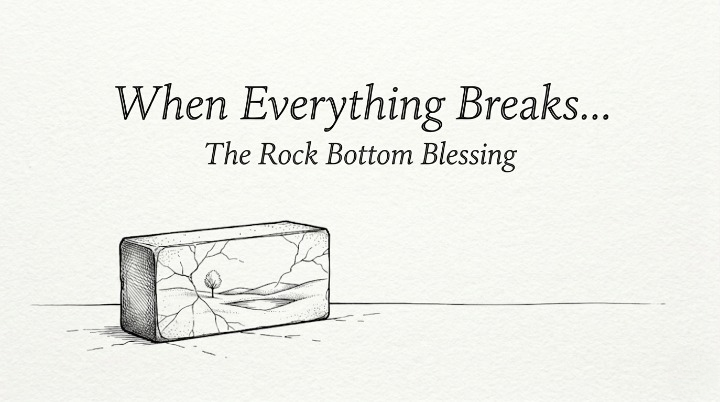
“You do not need to rebuild the entire house today. You just need to move one brick.”
We do not need to rebuild the entire house in a single day; we simply need to move one brick. Human beings are wired to find true joy not in the final destination, but in the simple act of making progress. By setting one tiny goal today and achieving it, we trigger a surge of confidence that shatters the final illusion of isolation. The heavy air will eventually clear, and this difficult chapter will ultimately be viewed as a necessary piece of our personal evolution.
The Take Action Bridge
If you are standing in the trenches right now, remember that you do not have to map out the entire mountain alone. You can begin shifting your momentum this very second by reclaiming your focus.
Download Your Identity Audit Worksheet
Stop drifting.
Turn the insights from this article into raw, actionable clarity.
Enter your email below to get the minimalist PDF blueprint and audit your internal standards, proximity circle, and hidden scripts right now.
Identity Audit Worksheet
is on the way to your email.
Chceck it right now!
Q&A: Understanding Time Reclamation
How do you overcome the feeling of isolation during a major life crisis?
Overcoming isolation requires us to actively break the dangerous urge to pull away and hide from the world. When we suffer, our instinct tells us to fix everything in total solitude, but this only magnifies the weight on our shoulders. We must realize that showing the courage to ask for help is a sign of strength, not vulnerability. There are always individuals who understand and are willing to hold space for us if we simply reach out.
Why does hitting rock bottom feel like a permanent failure, and how can we break this illusion?
Hitting rock bottom feels permanent because our minds suffer from a temporary amnesia during intense pain, convincing us that our current struggle is the only reality we have ever known. We break this illusion by intentionally journeying through our past history to recall previous setbacks we were certain we would never recover from. Realizing that those past giants eventually became distant shadows proves that our current heartbreak is also temporary. The floor is not a permanent destination; it is merely a blank slate for a new chapter.
What is the most effective way to rebuild motivation when everything has fallen apart?
The most effective way to rebuild motivation is to completely stop looking at the massive mountain ahead and focus entirely on microscopic victories. When everything feels overwhelming, trying to rebuild the entire house at once causes mental paralysis. Instead, we must set one simple, tiny goal today, achieve it, and then set a slightly bigger one tomorrow. The momentum built from these small actions triggers a surge of confidence that naturally restores our drive.
How does practicing appreciation alter your internal chemistry during difficult times?
Practicing appreciation in the middle of a crisis acts as an active tool for emotional survival rather than toxic positivity. When we force ourselves to find things to value amidst the wreckage, we consciously interrupt the brain’s automatic survival alarms. This intentional shift alters our internal chemistry, moving our focus away from a state of constant threat and into a state of open discovery. As a result, we become far better positioned to spot solutions that were previously hidden by our panic.